You crack open a cold one on a Friday afternoon. By the time you toss the empty in a bag and bring it to Unlimited Redemption, that can has already traveled further than most people realize — and what happens next is genuinely impressive.
Sixty days. That’s roughly how long it takes for a returned aluminum can to be melted down, reformed, refilled, and sitting on a store shelf again. No mining. No new raw material. Just the same aluminum doing its job a second time — or a hundredth.
Most people know recycling is good. Fewer people know how fast and how efficiently it actually works when the deposit system is doing its job. Here’s the full story, from your cooler all the way to a brand-new can.
Why Aluminum Is the Star of the Recycling World
Not all recyclable materials are created equal. Paper degrades in quality every time it’s recycled. Plastic has a limited number of cycles before it becomes unusable. Glass is heavy, expensive to transport, and has a rocky relationship with recycling markets.
Aluminum is different. It can be recycled indefinitely without losing any of its properties. The same aluminum atom that was pulled from the ground decades ago could be in your soda can today, your next can in two months, and cans for generations after that.
And recycling it uses about 95% less energy than producing new aluminum from raw bauxite ore. That gap is enormous. It’s the difference between running a lightbulb for a few seconds versus running it for hours. When you return a can, you’re not just getting your 5 cents back — you’re saving serious energy.
👉 Know More About The 95% Energy Rule
The Full Journey: Stage by Stage
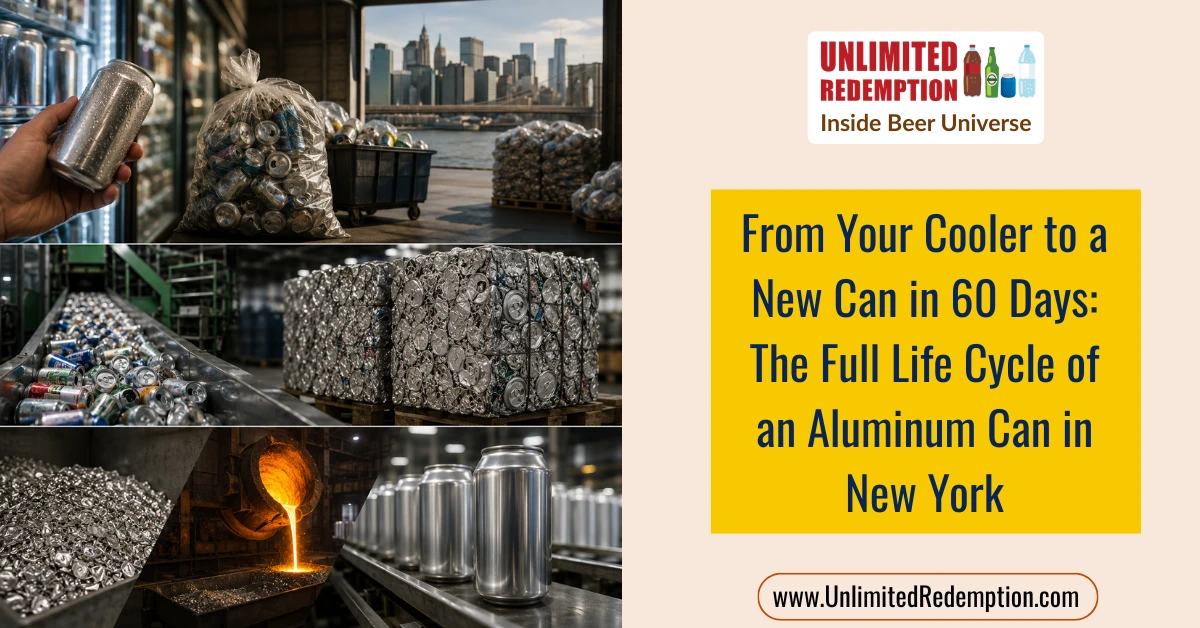
Here’s what actually happens to an aluminum can when you return it through New York’s deposit system — from the moment you hand it over to the moment it’s back in someone’s hand.
Stage 1: You Return the Can
You bring your empties to Unlimited Redemption — walk-in or scheduled pickup, wherever you are across the 15 Upstate New York locations. Every can is manually counted by staff. You receive 5 cents per eligible container, paid out on the spot. The cans are sorted and staged for collection.
Stage 2: Collection and Transport
Returned containers are collected from redemption centers and transported to a materials recovery facility. Because deposit containers come in pre-sorted by type — aluminum separate from glass and plastic — they skip a lot of the messy sorting that curbside recycling requires. This is one reason the deposit stream produces cleaner, higher-quality material.
Stage 3: Baling
At the recovery facility, aluminum cans are compressed into large, dense bales. A single bale typically contains thousands of crushed cans. These bales are efficient to store and transport, which keeps the cost of the recycling process down and makes aluminum one of the most economically viable materials to recycle at scale.
Stage 4: Shredding and Cleaning
The bales are shredded into small chips. Those chips go through a cleaning process that removes lacquer coatings, paint, and any residue from the original contents. What comes out the other side is clean aluminum — ready to be melted.
Stage 5: Melting and Casting
The cleaned aluminum chips go into a furnace running at over 1,200 degrees Fahrenheit. The material melts into liquid aluminum, which is then cast into large ingots — rectangular slabs that each contain the aluminum from roughly 1.5 million cans. These ingots are the raw material for the next generation of cans.
Stage 6: Rolling Into Sheet
The ingots are sent to rolling mills where they’re pressed into thin aluminum sheet — the same gauge used for beverage cans. This is where the material shifts from recycled scrap back into production-grade input, indistinguishable from aluminum made with virgin ore.
Stage 7: Can Manufacturing
Aluminum sheet goes to a can manufacturer. Circular blanks are punched out, drawn and ironed into can bodies, trimmed to height, and then decorated with graphics and text. The lids are formed separately and attached after filling. From flat sheet to finished can takes minutes on a modern production line.
Stage 8: Filling and Distribution
The finished cans are sent to beverage companies, filled, sealed, and packaged. They move through distribution networks to stores, wholesalers, and event vendors. Within weeks of leaving the can manufacturer, they’re on a shelf somewhere in New York State — carrying a new 5-cent deposit, waiting for someone to buy them.
Stage 9: Back in Your Hand
Someone buys the can. Drinks it. Returns it. The loop starts again. The aluminum in that can could complete this cycle dozens of times across a human lifetime — and each time it does, it skips the energy-intensive step of mining and refining new material from scratch.
👉 Learn How Unlimited Redemption Helps Non-Profits Run Bottle Drives
What Happens When the Loop Gets Broken
The 60-day cycle only works when the can makes it back to a redemption center. When it doesn’t, the story ends very differently.
- A can that goes into a landfill takes 80 to 200 years to decompose. It never becomes a new can.
- A can that goes into a curbside recycling bin might get recycled — or might end up in a landfill depending on contamination levels and commodity market conditions. The deposit stream is guaranteed. The blue bin is not.
- A can that ends up as litter on a roadside or in a waterway may eventually be collected by a volunteer cleanup crew, or it may stay there for years, slowly breaking down into fragments that enter the soil and water supply.
- Every can that doesn’t get returned also means new aluminum has to be produced somewhere to replace it — which means more mining, more energy, more emissions.
New York’s bottle deposit system exists specifically to keep that loop intact. The 5-cent deposit is the incentive. Redemption centers like Unlimited Redemption are the infrastructure. The two together make the 60-day cycle possible.
Where to Return Your Cans Across Upstate NY
Unlimited Redemption operates 15 bottle and can redemption centers across Upstate New York, all inside Beer Universe stores. Manual counting, no machine limits, open 7 days a week.
- Albany • Coxsackie • Amsterdam • Kingston • Saugerties
- Schenectady – Kelton Ave • Schenectady – Union St
- Troy – 5th Ave • Troy – Northern Dr • Troy – Hoosick St • Wynantskill
- Malta • Saratoga • Queensbury • Wilton
Can’t make the trip? Schedule a pickup through unlimitedredemption.com. The service covers a 20-mile radius from each location, so most of the Capital Region, Hudson Valley, and North Country are within range.
Community organizations — schools, faith groups, Boy Scout troops, police associations, golf courses, colleges, hospitals — can also partner with Unlimited Redemption to run bottle drives and direct deposit returns toward local fundraising goals.
Keep the Loop Going. Return Your Cans at Any of 15 Unlimited Redemption Locations Across Upstate New York — or Schedule a Pickup at unlimitedredemption.com
Frequently Asked Questions
Is it really true that a returned aluminum can can be back on shelves in just 60 days?
Yes — 60 days is a well-documented industry benchmark for the aluminum recycling turnaround when the system is running efficiently. The deposit return stream helps hit that timeline because containers arrive pre-sorted and clean, which speeds up processing compared to mixed curbside material. The actual time can vary slightly based on facility capacity and distribution schedules, but the 60-day figure is realistic and widely cited by the aluminum industry.
Why is returning cans to a redemption center better than putting them in the blue recycling bin?
The deposit return stream delivers cleaner, pre-sorted aluminum directly to recycling facilities, bypassing the mixed-material sorting process at municipal recovery facilities. Curbside recycling is subject to contamination — food residue, wrong materials in the bin — and to commodity market fluctuations that can result in recyclable material being sent to landfill instead. Returned deposit containers are guaranteed to be recycled. The blue bin is not.
Does aluminum quality degrade each time it’s recycled, like plastic or paper?
No — this is one of aluminum’s most remarkable properties. Unlike paper, which loses fiber strength with each cycle, or plastic, which degrades in quality after a limited number of recycling passes, aluminum can be recycled indefinitely without any loss of quality or performance. The aluminum in a can you return today could be recycled dozens or even hundreds of times across its lifetime, each time producing material identical to virgin aluminum.
I’ve heard that recycling doesn’t actually make a difference. Is that true for aluminum?
For aluminum specifically, that argument doesn’t hold up. Recycling aluminum uses roughly 95% less energy than producing new aluminum from raw bauxite ore — that’s not a marginal difference, it’s enormous. The aluminum industry actively depends on recycled material because it’s dramatically cheaper to process than virgin ore. Every can that comes back through the deposit system reduces energy consumption, cuts emissions, and reduces the demand for new mining. The impact is real, measurable, and well-documented.